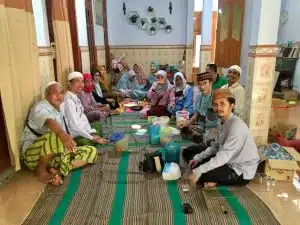
The seventh post in our alumni profile series for the 20th year of AIMEP is about Julia Novrita, a 2005 AIMEP alumna and community activist with a passion for empowering young people and sustaining peace.
Read her story below:
Julia Novrita
My mum was a teacher and my dad a civil servant. They both moved from their villages in Aceh to Sabang on Weh Island, and that’s where they met, and where I grew up. Although Sabang is small, it’s very diverse, and some foreigners visited for holidays when I was a child. This environment motivated me to learn English, and travelling abroad became my dream.

When I was 9 years old, my dad passed away, so my mother took the family back to her village, where I had the chance to learn to speak Acehnese. At first, I was so excited about living there. I had read many children’s books about living in the village as farmers, so I was looking forward to the experience of being one! But later I started to feel that everything was too homogenous.
When I was in middle school, I asked my mother if I could take an English course outside of the village, and she eventually agreed. Then I pushed to do high school in the city. She said, “Julia, we have high school here, so why do you need to go to the city where it’s more expensive?” But I told her I couldn’t stand it in the village anymore, and that I wanted to meet different people. Finally, she agreed to that as well.
That was very good of her because she was on a single income. I’m so touched now when I think about this. As I get older, I realise more and more how important she was in my life and how God really prepared the way for me. I used to sometimes wonder whether my dad would have supported all my aspirations the way she did. I tried to see the bright side of being fatherless, as a kind of coping mechanism.

After I finished school, I went on to study Economics. I found university campus life quite fun. I joined the campus radio station as a broadcaster, and practiced my English a lot with some friends there.
But after finishing, it was difficult for me to find a job because of nepotistic practices, and I had no connections to help me! Then I learned about different scholarship opportunities, which required some work experience. So, I started to volunteer at an organisation made up of women supporting internally displaced persons caused by the prolonged armed conflict in Aceh. One of the things we did was to provide alternative education for children whose schools had been destroyed. This social work made me realise that I had found my purpose!

Next, I moved to another challenging job at the Henry Dunant Centre as a translator and facilitator trying to resolve the ongoing conflict between the Free Aceh Movement and the Indonesian government through negotiations. I was very lucky to get this role due to the languages I spoke: Acehnese, Indonesian and English. I was assigned to high level meetings where important issues were discussed, which was not usual for Acehnese women at that time. Unfortunately, the negotiations were not successful, and I was so sad and heartbroken by that.
Four months later, I flew to Denmark to participate in the Asia Europe youth camp training. Finally, my childhood dream had come true! At first, I was nervous about this long trip but I was very lucky that I met nice people all the way. And Denmark was just amazing, such a peaceful country, and one of the happiest in the world – a perfect place to mend my broken heart. On the way home, I couldn’t hold back my tears, because I didn’t want to leave!

Next, I learned about the Australia Indonesia Muslim Exchange Program (AIMEP), and again I was lucky to be accepted into that. I’m still connected to the network I made there with my cohort, and it gave me some ideas for how we could do things differently in Indonesia. For example, I was very interested in the technology used in education in Australia, and I loved going to Questacon, the National Science and Technology Centre, in Canberra. I was also impressed by how refugees were supported in Australia.
Next, I got a scholarship to do a Masters in the US, studying Intercultural Service, Leadership, and Management at the School for International Training. My husband had actually got the same scholarship earlier. We met and got married before my departure, and then had a long-distance relationship for two years.
After my return, we lived in Sorong, then moved to Ambon where, with another person, we co-founded an NGO called InDev. Our organisation seeks to strengthen the capacity of community groups, NGOs, governments and education institutions through training, research, and consultancy. In 2011, we initiated a youth-led program “Non-Violent Study Circles” with the mission of “Sustaining Peace from Campus to Community” in 2011. Recently, I also completed a PhD in International Education at the University of Massachusetts at Amherst, with my research focused on the role of students in promoting peace and reconciliation.
I always say to the younger generation, “If something bothers you, do something about it.” Sometimes I hear adults saying things to young people like, “Oh, you’re so passionate, just like I used to be, but some day when you enter the workforce, you will become realistic.” For them, “realistic” means you have no idealism left at all. But I say, “Never bury your dreams.” Because sooner or later you will find the moment to make them come true.

Julia Novrita
Aceh, Indonesia
AIMEP 2003
Photographer: Ferry Yanuar